
reinstall




One-Click Script to Reinstall System 中文

Highlights
- One-click Linux installation: Supports 17 common distributions.
- One-click Windows installation: Uses the official ISO for installation instead of custom images. The script automatically retrieves the ISO link and installs
Virtioand other drivers. - Supports installation in any direction, i.e.,
Linux to Linux,Linux to Windows,Windows to Windows,Windows to Linux - No need to input IP parameters; automatically recognizes dynamic and static IPs, supports
/32,/128,gateway outside subnet,IPv6 only,dual NICand other special network configurations - Specially optimized for low-spec servers, requires less memory than the official netboot
- Uses partition table ID to identify hard drives throughout the process, ensuring no wrong disk is written
- Supports BIOS and EFI boot, and ARM Server
- No homemades image included, all resources are obtained in real-time from mirror sites
- Includes many comments.
System Requirements
The original system can be any system listed in the table.
The system requirements for the target system are as follows:
| Target System | Version | Memory | Disk |
|---|---|---|---|
| 3.18, 3.19, 3.20, 3.21 | 256 MB | 1 GB | |
| 9, 10, 11, 12 | 256 MB | 1 ~ 1.5 GB ^ | |
| Rolling | 256 MB | 1 ~ 1.5 GB ^ | |
 Ubuntu Ubuntu |
16.04 LTS - 24.04 LTS, 24.10 | 512 MB * | 2 GB |
 Anolis Anolis |
7, 8, 23 | 512 MB * | 5 GB |
 Rocky Rocky  Oracle Oracle |
8, 9 | 512 MB * | 5 GB |
| 8, 9, Stream 23 | 512 MB * | 5 GB | |
 CentOS CentOS |
9, 10 | 512 MB * | 5 GB |
| 40, 41 | 512 MB * | 5 GB | |
| 20.03 LTS - 24.03 LTS, 24.09 | 512 MB * | 5 GB | |
 openSUSE openSUSE |
15.6, Tumbleweed (Rolling) | 512 MB * | 5 GB |
| 24.11 | 512 MB | 5 GB | |
 Arch Arch |
Rolling | 512 MB | 5 GB |
 Gentoo Gentoo |
Rolling | 512 MB | 5 GB |
 Windows (DD) Windows (DD) |
Any | 512 MB | Depends on image |
| Windows (ISO) |
Vista, 7, 8.x (Server 2008 - 2012 R2) | 512 MB | 25 GB |
| Windows (ISO) |
10, 11 (Server 2016 - 2025) | 1 GB | 25 GB |
* Indicates installation using cloud images, not traditional network installation.
^ Indicates requiring either 256 MB memory + 1.5 GB disk, or 512 MB memory + 1 GB disk
Warning
❌ This script does not support OpenVZ or LXC virtual machines.
Please use https://github.com/LloydAsp/OsMutation instead.
Download (Current system is  Linux)
For server outside China:
curl -O https://raw.githubusercontent.com/bin456789/reinstall/main/reinstall.sh || wget -O reinstall.sh $_
For server inside China:
curl -O https://gitlab.com/bin456789/reinstall/-/raw/main/reinstall.sh || wget -O reinstall.sh $_
Download (Current system is Windows)
Important
Before proceeding, please disable the 'Real-time protection' feature in
Windows Defender. This feature may preventcertutilfrom downloading any files.
Resolving Script Download Issues on Windows 7
Due to lack of support for TLS 1.2, SHA-256, or outdated root certificates, Windows Vista, 7, and Server 2008 (R2) may not be able to download scripts automatically. Manual downloading is required, as follows:
Use Internet Explorer (enable TLS 1.2 in IE's advanced settings first) to download, or use Remote Desktop to save the following two files into the same directory:
To use, run the downloaded reinstall.bat.
For server outside China:
certutil -urlcache -f -split https://raw.githubusercontent.com/bin456789/reinstall/main/reinstall.bat
For server inside China:
certutil -urlcache -f -split https://gitlab.com/bin456789/reinstall/-/raw/main/reinstall.bat
Usage
All features can be used on both Linux and Windows.
- on Linux, execute
bash reinstall.sh - on Windows, execute
.\reinstall.bat
Feature 1: Install Linux
- The username is
rootwith a default password of123@@@. - When installing the latest version, the version number does not need to be specified.
- Maximizes disk space usage: no boot partition (except for Fedora) and no swap partition.
- Automatically selects different optimized kernels based on machine type, such as
CloudorHWEkernels. - When installing Red Hat, you must provide the
qcow2image link obtained from https://access.redhat.com/downloads/content/rhel. You can also install other RHEL-based OS, such asAlibaba Cloud LinuxandTencentOS Server. - After reinstallation, if you need to change the SSH port or switch to key-based login, make sure to also modify the files inside
/etc/ssh/sshd_config.d/.
bash reinstall.sh anolis      7|8|23
                  opencloudos 8|9|23
                  rocky       8|9
                  redhat      8|9   --img='http://xxx.com/xxx.qcow2'
                  oracle      8|9
                  almalinux   8|9
                  centos      9|10
                  fedora      40|41
                  nixos       24.11
                  debian      9|10|11|12
                  opensuse    15.6|tumbleweed
                  alpine      3.18|3.19|3.20|3.21
                  openeuler   20.03|22.03|24.03|24.09
                  ubuntu      16.04|18.04|20.04|22.04|24.04|24.10 [--minimal]
                  kali
                  arch
                  gentoo
Optional Parameters
--password PASSWORDSet the password--ssh-port PORTChange the SSH port (for log observation during installation and for the new system)--web-port PORTChange the Web port (for log observation during installation)--hold 2Prevent reboot after installation completes, allowing SSH login to modify system content; the system is mounted at/os(this feature is not supported on Debian/Kali).
Tip
When installing Debian/Kali, x86 architectures can monitor the installation progress through VNC in the background, while ARM architectures can use the serial console.
When installing other systems, can monitor the progress through various methods (SSH, HTTP 80 port, VNC in the background, serial console).
Even if errors occur during the installation process, you can still install to Alpine via SSH by running/trans.sh alpine
Experimental Features
Install Debian using a cloud image
- Suitable for machines with slower CPUs
bash reinstall.sh debian --ci
Install CentOS, AlmaLinux, Rocky, Fedora using ISO
- Only supports machines with more than 2G of memory and dynamic IP.
- Password is
123@@@, and the SSH port is22; modifying them using parameters is not supported.
bash reinstall.sh centos --installer
Install Ubuntu using ISO
- Only supports machines with more than 1G of memory and dynamic IP.
- Password is
123@@@, and the SSH port is22; modifying them using parameters is not supported.
bash reinstall.sh ubuntu --installer
Feature 2: DD
- Supports
rawandvhdimage formats (either uncompressed or compressed as.gz,.xz,.zst,.tar,.tar.gz,.tar.xz,.tar.zst). - When deploy a Windows image, the system disk will be automatically expanded, and machines with a static IP will have their IP configured, and may take a few minutes after the first boot for the configuration to take effect.
- When deploy a Linux image, will NOT modify any contents of the image.
bash reinstall.sh dd --img https://example.com/xxx.xz
Optional parameters
--allow-pingAllow ping responses (DD Windows only)--rdp-port PORTChange RDP port (DD Windows only)--ssh-port PORTChange SSH port (for log observation during installation)--web-port PORTChange Web port (for log observation during installation)--hold 2Prevent reboot after the DD process finishes, allowing SSH login to modify system content. The Windows system will be mounted at/os, but Linux systems will NOT be automatically mounted.
Tip
Can monitor the progress through various methods (SSH, HTTP 80 port, VNC in the background, serial console).
Even if errors occur during the installation process, you can still install to Alpine via SSH by running/trans.sh alpine
Feature 3: Reboot to  Alpine Live OS (RAM OS)
- You can use SSH to backup/restore disk, manually perform DD operations, modify partitions, and manually install Alpine, Arch, Gentoo, and other systems.
- Username
root, Default password123@@@ - If manual operations do not damage the original system, rebooting will return to the original system.
bash reinstall.sh alpine --hold=1
Optional parameters
--password PASSWORDSet password--ssh-port PORTChange SSH port
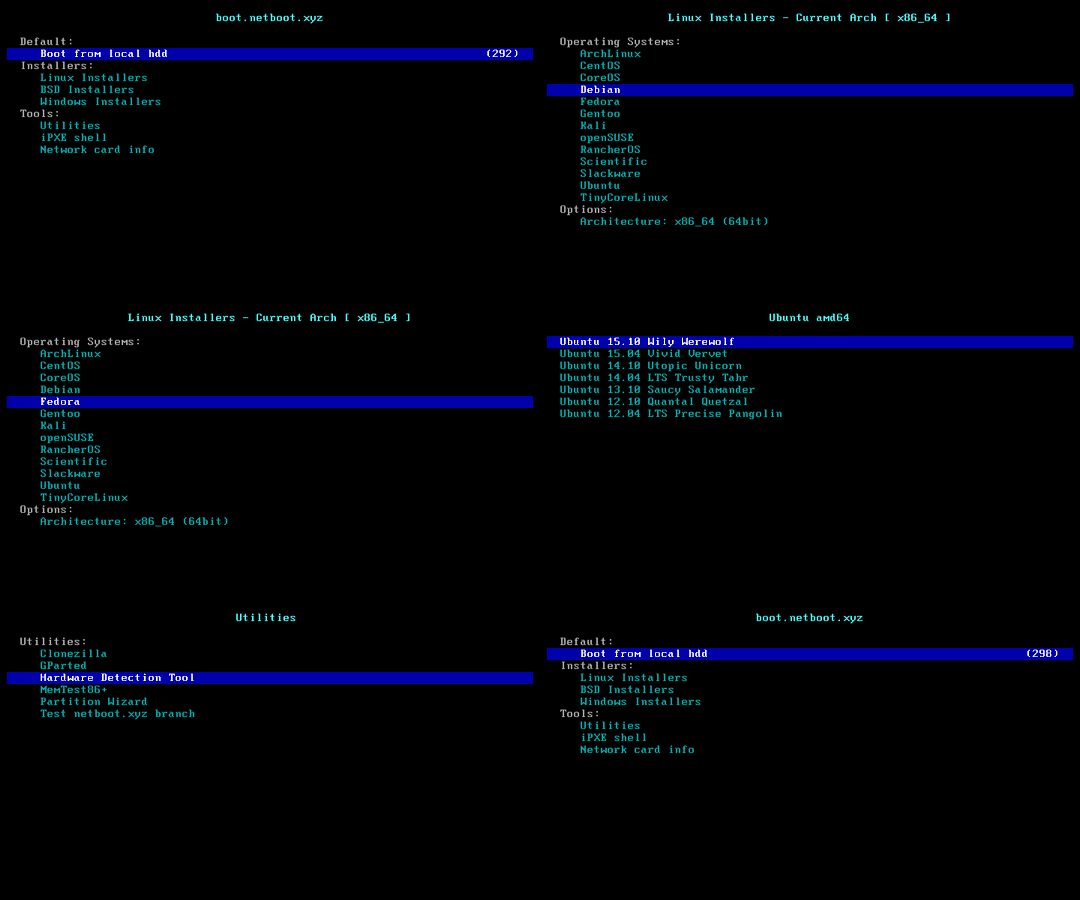
Feature 4: Reboot to  netboot.xyz
- Can manually install more systems using vendor backend VNC.
- If manual operations do not damage the original system, rebooting will return to the original system.
bash reinstall.sh netboot.xyz
Feature 5: Install Windows ISO
- Username
administrator, Default password123@@@ - If remote login fails, try using the username
.\administrator. - The machine with a static IP will automatically configure the IP. It may take a few minutes to take effect on the first boot.
- Supports all languages.
Supported Systems
- Windows (Vista ~ 11)
- Windows Server (2008 ~ 2025)
- Windows Server Essentials *
- Windows Server (Semi) Annual Channel *
- Hyper-V Server *
- Azure Stack HCI *
Method 1: Let the Script Automatically Search for ISO
Caution
The ISO repository currently prohibits direct link downloads, so this method is no longer effective.
- The script will search for ISOs from https://massgrave.dev/genuine-installation-media, a site that collects official ISOs.
- Systems marked with * do not support automatic ISO searching.
bash reinstall.sh windows \
     --image-name 'Windows 11 Enterprise LTSC 2024' \
     --lang zh-cn
Supported languages
ar-sa
bg-bg
cs-cz
da-dk
de-de
el-gr
en-gb
en-us
es-es
es-mx
et-ee
fi-fi
fr-ca
fr-fr
he-il
hr-hr
hu-hu
it-it
ja-jp
ko-kr
lt-lt
lv-lv
nb-no
nl-nl
pl-pl
pt-pt
pt-br
ro-ro
ru-ru
sk-sk
sl-si
sr-latn-rs
sv-se
th-th
tr-tr
uk-ua
zh-cn
zh-hk
zh-tw
Method 2: Specify the ISO link manually
- If you don't know the
--image-name, you can enter any value. After rebooting, connect via SSH and re-enter the correct value based on the error messages.
bash reinstall.sh windows \
     --image-name 'Windows 11 Enterprise LTSC 2024' \
     --iso 'https://go.microsoft.com/fwlink/?linkid=2289029'
The following website provides ISO links.
- General
- Evaluation
- https://www.microsoft.com/evalcenter/download-windows-10-enterprise
- https://www.microsoft.com/evalcenter/download-windows-11-enterprise
- https://www.microsoft.com/evalcenter/download-windows-11-iot-enterprise-ltsc-eval
- https://www.microsoft.com/evalcenter/download-windows-server-2012-r2
- https://www.microsoft.com/evalcenter/download-windows-server-2016
- https://www.microsoft.com/evalcenter/download-windows-server-2019
- https://www.microsoft.com/evalcenter/download-windows-server-2022
- https://www.microsoft.com/evalcenter/download-windows-server-2025
- Insider Preview
Optional parameters
--password PASSWORDSet Password--allow-pingConfigures the Windows firewall to allow ping requests--rdp-port PORTChange RDP port--ssh-port PORTChange SSH port (for log observation during installation)--web-port PORTChange Web port (for log observation during installation)--add-driver-dir DIRAdds an additional driver folder, specifying the folder where the .inf file is located.- The driver must be downloaded locally first.
- This parameter can be set multiple times to add different driver folders.
- The script will copy the entire folder, so no other files should be placed inside the folder.
--hold 2Allow SSH connections for modifying the disk content before rebooting into the official Windows installation program, with the disk mounted at/os.
The script will automatic download and install the following drivers as needed, without the need for manual addition
- Virtio (Virtio, Alibaba Cloud)
- XEN (XEN, Citrix, AWS)
- AWS (ENA Network Adapter, NVMe Storage Controller)
- GCP (gVNIC Network Adapter, GGA Display Adapter)
- Azure (MANA Network Adapter)
- Intel (VMD Storage Controller)
How to Specify the Image Name --image-name
Typically, an ISO will contain multiple system versions, such as Home Edition and Professional Edition. The image name --image-name is used to specify the version to be installed, and it is case-insensitive when entered.
You can use tools like DISM, DISM++, or Wimlib to query the image names included in the ISO.
Commonly used image names include:
Windows 7 Ultimate
Windows 11 Pro
Windows 11 Enterprise LTSC 2024
Windows Server 2025 SERVERDATACENTER
How to Use DISM++ to Query the Image Names Included in the ISO
Open File menu > Open Image File, select the iso to be installed to get the image name (full system name), and all available image names are installable.
Warning
Vista (Server 2008) and 32-bit systems may lack drivers.
Warning
For EFI machines without CSM enabled, Windows 7 (Server 2008 R2) cannot be installed.
Hyper-V (Azure) requires selecting the appropriate VM generation: https://learn.microsoft.com/windows-server/virtualization/hyper-v/plan/should-i-create-a-generation-1-or-2-virtual-machine-in-hyper-v
Warning
In the Chinese version of Windows 10 LTSC 2021 ISO
zh-cn_windows_10_enterprise_ltsc_2021_x64_dvd_033b7312.iso, thewsappxprocess may indefinitely consume CPU resources.The solution is to update the system patches or manually install the
VCLibslibrary https://www.google.com/search?q=ltsc+wsappx.
Considerations for Installing Windows on ARM
Most ARM machines support installing Windows 11 24H2.
During the installation process, you might encounter a black screen, and the serial console may display ConvertPages: failed to find range, but neither issue affects the installation.
| Compatibility | Cloud Provider | Instance Type | Issues |
|---|---|---|---|
| ✔️ | Azure | B2pts_v2 | |
| ✔️ | Alibaba Cloud | g6r, c6r | |
| ✔️ | Alibaba Cloud | g8y, c8y, r8y | There is a chance of hanging at the boot logo during restart; forced reboot will resolve it. |
| ✔️ | AWS | T4g | |
| ✔️ | Scaleway | COPARM1 | |
| ✔️ | Gcore | ||
| ❔ | Oracle Cloud | A1.Flex | Installation success is not guaranteed; newer instances are more likely to succeed. Manual loading of GPU drivers is required after installation. |
| ❌ | Google Cloud | t2a | Missing network card drivers |
Loading Graphics Driver on Oracle Cloud
Log in to the server using Remote Desktop, open Device Manager, locate the graphics card, select "Update Driver," and choose Red Hat VirtIO GPU DOD controller from the list. There's no need to download the drivers in advance.
Discussion


How to Modify the Script for Your Own
- Fork this repository.
- Modify the
confhomeandconfhome_cnat the beginning ofreinstall.shandreinstall.bat. - Make changes to the other code.
Thanks

Thanks to the following businesses for providing free servers.